
From Vulnerability to Opportunity: Mekarya’s Pathway to Grassroots Resilience and Just Transition through Entrepreneurship and Innovative Finance

Image: Pixabay
Bali’s tourism-dependent economy has long been celebrated for its rapid growth and global appeal. Yet beneath this success, many workers, households, and local entrepreneurs remain profoundly vulnerable to recurring systemic shocks and disasters. When livelihoods depend almost entirely on a single hospitality sector, external disruptions—such as the devastating tourism collapse during the COVID-19 pandemic, airport shutdowns from Mount Agung’s volcanic eruptions, and severe flash floods (banjir bandang) and landslides—can instantly paralyze household cash flows and trigger acute socio-economic crises.
For communities living under this pressure, transition cannot simply mean asking people to change how they live or work. A meaningful Just Transition must also create new choices and economic opportunities.
This is the starting point for Program Mekarya, developed by Just Transition Indonesia (JTI) together with local businesses that can play both financing and market-building roles.
Rather than positioning Mekarya as a programme that simply advocates for Just Transition, Mekarya takes a practical approach: building entrepreneurial capacity, creating second sources of income, and connecting emerging enterprises to appropriate finance and markets.
Through entrepreneurship and socio-entrepreneurship development, technical assistance, mentorship, and blended finance, Mekarya supports local workers and entrepreneurs to develop and grow additional income streams without immediately abandoning their existing livelihoods.
The ambition is simple: to move communities from vulnerability to opportunity, and from reactive survival toward greater economic agency.
From Economic Pressure to Economic Choice
For households already experiencing economic pressure, adaptation can become a series of compromises—reducing expenditure, taking on additional work, postponing education or investment, or accepting increasingly precarious employment.
Mekarya seeks to create economic options before a crisis makes those options urgent.
A second source of income can provide more than additional earnings. It can reduce dependence on a single livelihood, increase household capacity to absorb shocks, and create greater room for decision-making.
This is where entrepreneurship becomes a practical pathway toward Just Transition.
Mekarya helps participants explore how their existing skills, knowledge, relationships, assets, and local resources can become viable economic opportunities. The goal is not necessarily to replace their primary employment, but to diversify and strengthen their economic base.
Building Entrepreneurs and Socio-Entrepreneurs
Mekarya recognises that not every participant needs to become a conventional entrepreneur. Some may develop businesses that generate additional household income; others may create enterprises that address social or environmental challenges while generating economic value.
The programme therefore builds capabilities in:
entrepreneurial thinking and leadership;
business model and financial planning;
legal and administrative formalisation;
market development and networking;
resource-efficient and regenerative practices;
mentorship and technical assistance; and
access to appropriate finance.
Resilience is not created simply by giving people a business opportunity. It requires capability, markets, networks, systems, and capital to work together.
From Grants to Markets: The Triple-Win Model
A distinctive element of Mekarya is the role of local businesses as both grantors and potential off-takers.
Traditional community programmes often separate funding from markets. A grant may help an entrepreneur start a business, but once the grant ends, the entrepreneur still needs customers and recurring revenue.
Mekarya seeks to connect these two sides.
Local businesses can provide early-stage grants or catalytic support to help entrepreneurs test and develop their business models. They can then become customers or off-takers for the products and services those entrepreneurs provide.
For example, a hospitality business could support an eco-laundry enterprise through catalytic funding and subsequently purchase its services. A property-related business could support the development of climate-adaptation capabilities and later procure renovation, water-management, or energy-efficiency services.
This creates the Mekarya Triple Win:
Entrepreneurs win through finance, mentorship, market access, and new income opportunities.
Local businesses win through access to locally relevant products and services that can improve efficiency, resilience, sustainability, and supply chains.
Communities and ecosystems win through more diversified livelihoods, locally owned enterprises, climate adaptation, and more sustainable local economies.
The model therefore moves beyond philanthropy:
Capital creates the opportunity. Markets create the sustainability. Community value creates the transition impact.
Blended finance becomes a bridge between community potential and market viability, helping enterprises move from grant-supported experimentation toward recurring market-based revenue.
Three Community-Anchored Pilot Tracks
1. Eco-Laundry for Villas and Households
Led by Pak Ketut (I Ketut Yoga Pradana) and his family, this venture is developing a professional, environmentally responsible laundry service for local households and commercial accommodation providers.
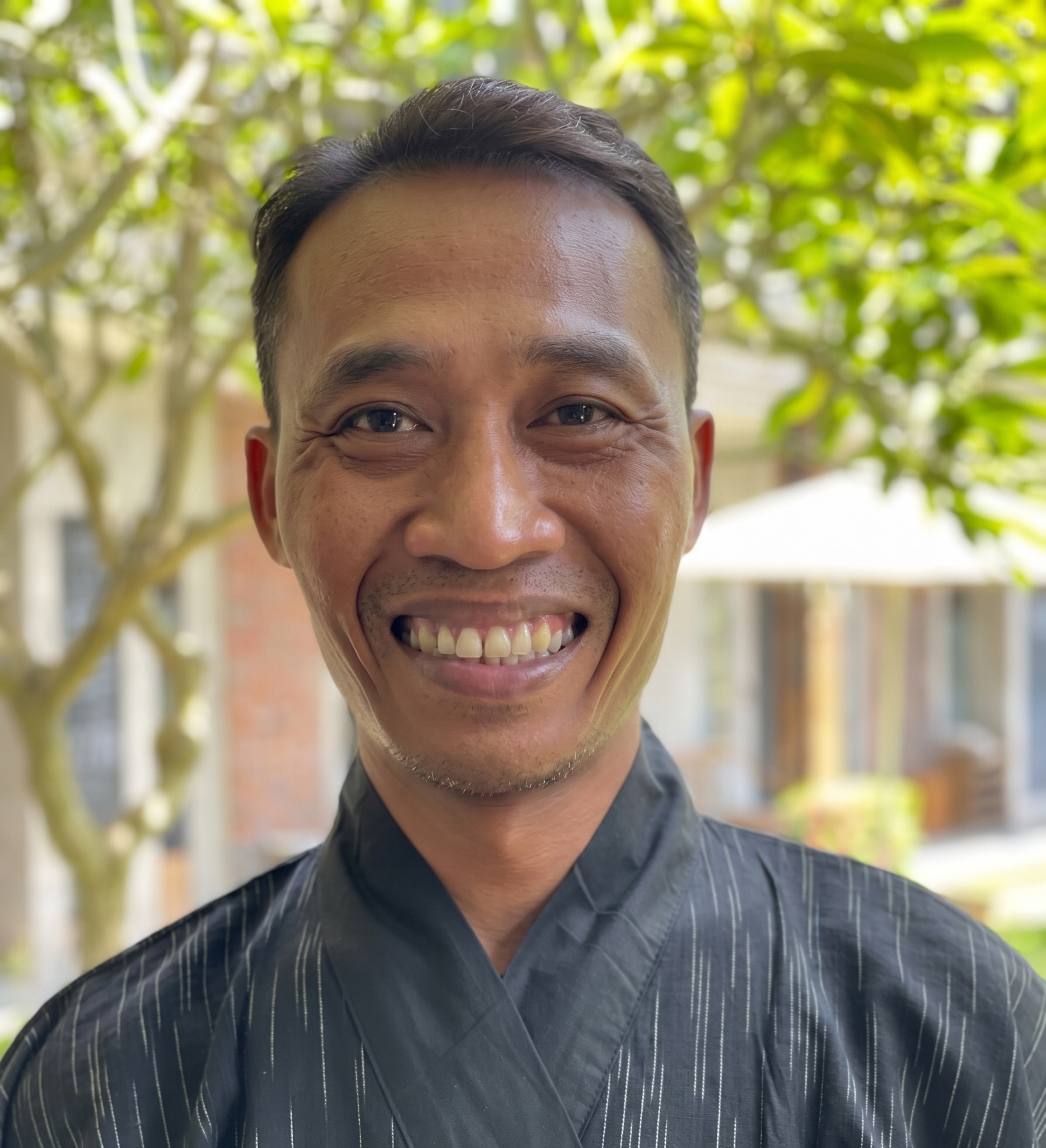
The pilot focuses on executable SOPs and governance, energy and water efficiency, biodegradable detergents, and wastewater management. It demonstrates how a small enterprise can create additional household income while responding to real demand from Bali’s hospitality economy.

2. Regenerative Education and Climate-Adaptive Property Management
Led by Marta Efrosina Bertha, this track is developing a longer-term vision combining regenerative education with practical climate-adaptation services for properties.
The vision is for properties managed by Martha to provide educational and regenerative value while helping owners improve climate resilience through services such as roof reinforcement for future solar PV, greywater harvesting, water efficiency, drainage and flood resilience, heat reduction, energy efficiency, and other appropriate renovations.
This creates the potential for a socio-entrepreneurial model combining education, property management, and climate adaptation—turning adaptation itself into a viable service while helping tourism-related properties become more resilient and resource-efficient.

3. Sustainable Livestock and Food Security — Pre-FS
Spearheaded by I Kadek Rai Yasta (Angga), this track is developing a data-driven Pre-Feasibility Study for a manageable livestock enterprise.
The objective is to identify practical, low-cost models, potentially including poultry, that can strengthen household food security and generate additional income without interfering with primary employment.
The pilot explores the intersection of food security, livelihood diversification, and enterprise development, with potential for future business partnerships and off-take arrangements.

A Grassroots Pathway to Just Transition
Just Transition is often discussed through national policy, climate commitments, energy systems, and large-scale economic transformation. These are essential, but transition ultimately takes place in people’s lives and livelihoods.
For a worker whose income depends on tourism, transition may begin with a simple question: What happens if my main source of income is no longer enough?
The answer cannot simply be “adapt.” There must be viable alternatives.
Mekarya explores how those alternatives can be built from the grassroots—by developing entrepreneurs and socio-entrepreneurs, diversifying household income, strengthening local enterprises, and connecting them with catalytic finance and real market demand.
In this way, economic diversification becomes a practical entry point for Just Transition.
Mekarya does not claim that entrepreneurship or blended finance alone can deliver a Just Transition. Rather, they can help create something fundamental: greater economic agency and resilience at the household and community level.
Looking Ahead
Mekarya is an evolving experiment in how grassroots economic initiatives can move from ideas to viable enterprises.
The next stage is not simply about creating more businesses. It is about identifying models that can survive, grow, generate meaningful additional income, create social and environmental value, and attract appropriate finance and market demand.
The longer-term ambition is an ecosystem in which local businesses identify needs and create demand, entrepreneurs develop solutions, catalytic capital bridges early-stage risks, and successful enterprises generate revenue and further economic opportunities.
Ultimately, Mekarya begins with a simple premise:
Communities cannot transition fairly if they do not have the economic capacity to choose their future.
By building entrepreneurs, socio-entrepreneurs, diversified livelihoods, market linkages, and pathways to appropriate finance, Mekarya seeks to help create that capacity.
From vulnerability to opportunity. From grants to markets. From dependence to greater economic agency. And from economic pressure toward a more resilient and just transition.


Comments